
I just read the Yardi Matrix monthly National Multifamily Report. The headline “Multifamily Rents Gain in April, but Fall Year-Over-Year” is factually correct; however, I think the tone misses the point a bit.
If I was the editor, I think I would write the headline as “Multifamily Rents Fall Further Behind Prior Year Despite Relatively Easy Comps.” And I might add a subtitle, “Seasonal month-over-month gain lags prior year”
I went and dug up a couple of prior Yardi Matrix National Reports (good thing I store them), and you can see that we hit $1700 average rents for the first time back in about June of 2022 which means we’ve gone almost four full years with just barely an aggregate rent growth of 3%. That’s about 15 months on “historical rent growth” stretched out over a 36-month period. Note: I’m not sure the exact date that Yardi switched from reporting actual rents to asking rents, but I’m pretty sure it was less than 4 years ago. Given that actual rents almost always are lower than asking rents, this means that 3% aggregate growth number is actually high!
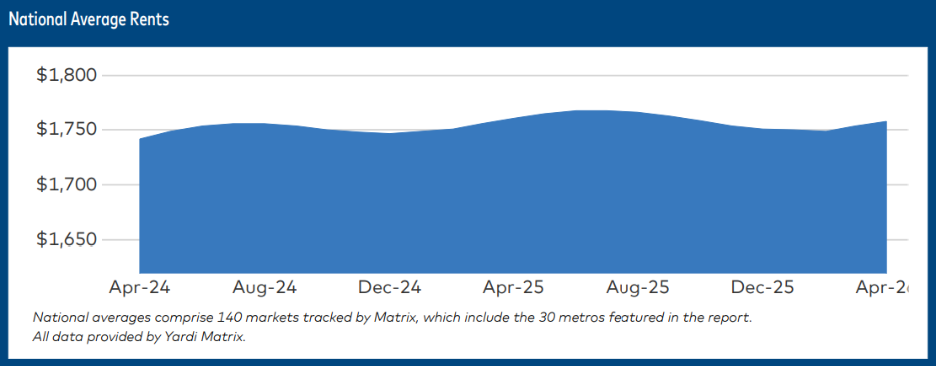
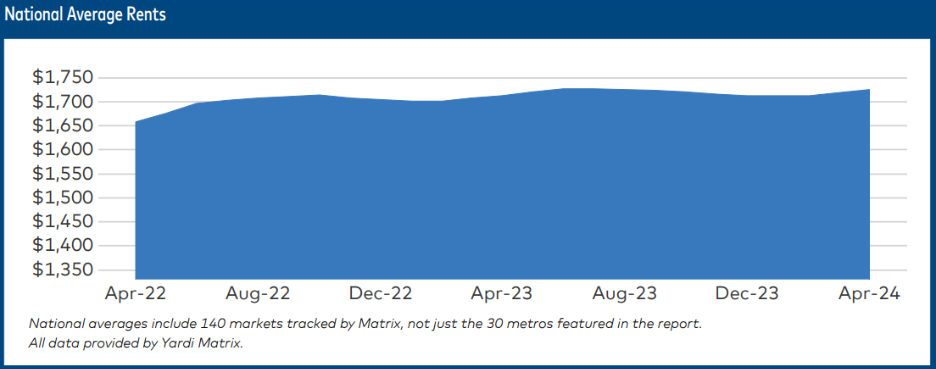
This is a truly unprecedented period of lack of growth, especially in the face of headline inflation back above 3%--unlike anything I’ve encountered in my 27 years in the industry and unlike anything I’m likely to encounter in what remains of my career.
Despite this reality, I rarely see any articles or conference sessions dedicated to dealing with this period of rent stagnation. In fact, I remember that the narrative in January 2025 was, “tough 1st half, expected strong 2nd half.” Of course, that latter lift, as proven by the Yardi Matrix analysis, never materialized.
Guess what I heard in the early 2026 conference season? “Tough 1st half, expected strong 2nd half.” And again, this is not going to happen. If anything, 2026 is proving to be worse on rent growth than 2025—at least 2025 had a very small positive growth.
So, what do we do about this? We can curse the wind, or we can set a better sail. If I was a COO, here’s how I would face up to this reality and “the better sails” I would set:
- Use data to make better decisions, faster. One of the more interesting things in my consulting career was working with c-suite executives evaluating BI solutions. Those who never had it struggled to understand (and believe) the seemingly intangible benefits against the hard cost of buying or building a BI platform; however, executives who had experienced a good BI platform but changed to a new job without it immediately made it a “top two” priority. They felt blind without it and simply couldn’t (and wouldn’t) live with that. A strong analytical platform is critical for managing a world where there is NOT a rising tide lifting all boats.
- Understand concessions better. With better data comes a better understanding of business decisions; and none is more important in challenging times than concessions. Yet decisions on concessions in 2026 are largely made the same way as they were in 1996: gut feel and comparison to competitors. It’s thus critical to understand when and how concessions really work? What is the market response to $2400 with a month free versus $2200? Are concessions more or less effective when competitors are offering them? It’s time to know the answer, not just guess.
- Use your data platform to understand local differences. It may sound trite, but all real estate is local, and the Yardi report proved that again, showing a 10-point swing in growth from the lowest growth market (Austin) versus the highest growth location (New York City). Sweeping generalizations or recent rules of thumb will underperform real and recent data. Yesteryear’s darlings can be this year’s dogs and vice versa.
- Dimes and quarters matter: When there is no rising tide, we need to find other sources of lift. I’ve written about this before and it’s still true. Most properties have missing and mis-labeled unit amenities, wildly incorrect square footage premiums and have never statistically-assessed the efficacy of current unit amenity pricing. That last one is even more important in challenging times as I know from prior analysis that the willingness to pay for “upgrades” and “extras” varies substantially during downturns compared to normal and bull market periods. Reach out to me if you’d like to learn more about how to quickly and easily do all these analyses.
- Use your budget and reforecast process to better understand your business. Most companies go through a costly and painful budgeting process summer into fall and then it’s just a target for bonuses. And if you’re using Excel, that’s probably all you have time for. But there is a world where frequent reforecasts are easy and where budgets both drive your understanding of the business and become the way you help your operating teams improve their performance. Sounds too good to be true? Give me a call! 😀
All of the above tactics can be done quickly to make an impact. And while it’s imperative to move fast to improve performance in a flat rent growth world, we shouldn’t ignore longer-term moves to put us in a better place for all future market conditions. Here are two strategies I would be sure to follow:
- Look for platform synergies. Leaders in our industry regularly complain about the rat’s nest of tech they have that doesn’t talk to each other. Yet they are getting exactly what they are asking for even if they don’t always realize they were asking for it. If you are “scratching itches” with individual point solution source selections, then that rat’s nest of non-connected tech is the natural and logical consequence of that approach. I would focus on a platform-based strategy, asking myself what I want my customer-facing platform to be…and what I want my back-office analytics platform to be. I would make my choices based on where I want to be 3-5 years from now, not just what I see today.
-
DIY and partner. The opportunities for “do it yourself” code that Claude and other AI coding tools create are real. This creates an allure for operators to build more rather than buy. And while there are certainly opportunities to gain control and save some expenses, there are hidden costs to this approach: 1) you have to build everything, even the basic foundation, yourself taking on an immense amount of tech debt and 2) you become isolated from a broader community that can teach you and provide other insights that are hard to see when alone. That’s why I would embrace a “buy and build” approach where I buy the foundational pieces and use my resources to build my advantage on top of that. This means I would do DIY, and I would find partners who make it easier to do my DIY…and who can continuously teach and challenge me (and I would teach and challenge them).
We can’t change the market's condition, but we can change how we react to it. Are you ready to step up and say, “Game on!”?




SHARE